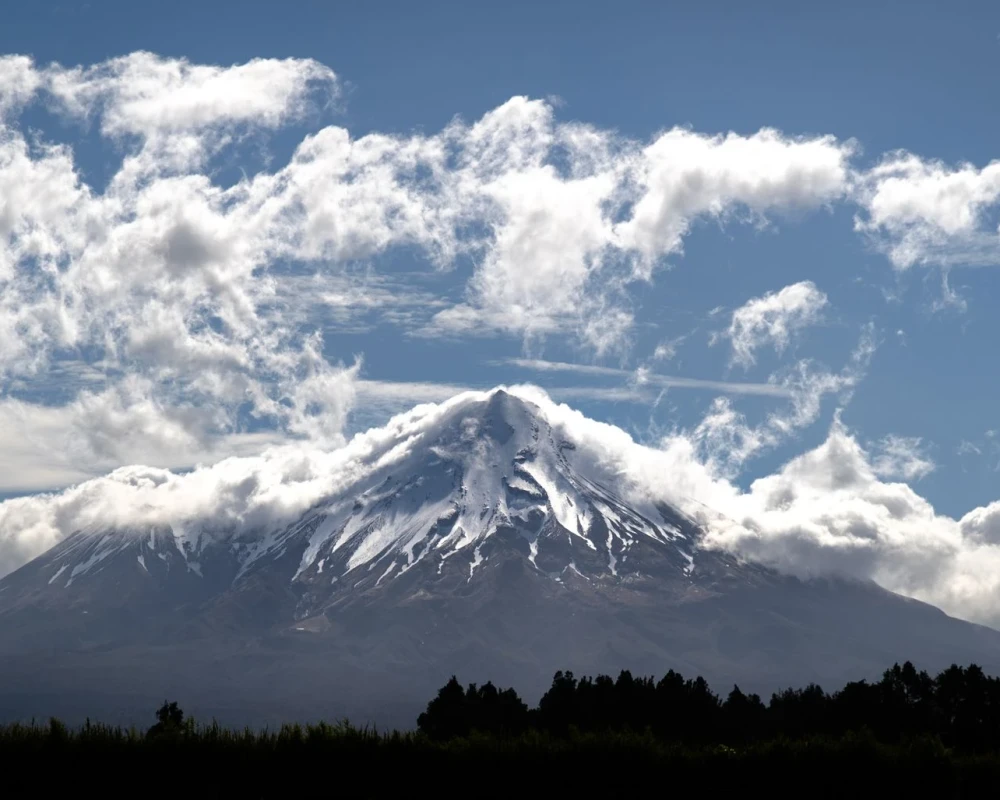
Mount Taranaki
Posted by Golden Chain NZ on May 19, 2026, 3:22 AM


Why Taranaki Maunga Should Be On Your New Zealand Radar
It genuinely looks unreal
At 2,518 metres, Taranaki Maunga (also long known as Mount Egmont) is the second-highest peak in the North Island after Mount Ruapehu. What sets it apart is its shape: a near-perfect cone that's drawn comparisons to Mount Fuji for decades. It's such a convincing stand-in that the mountain played the backdrop for Mount Fuji in the 2003 film The Last Samurai.
The volcano even has a smaller companion, Fanthams Peak (Panitahi), sitting on its southern flank at 1,966 metres — named after Fanny Fantham, the first European woman known to have climbed it, back in 1887.
It's a dormant volcano with a serious résumé
Taranaki is a stratovolcano that's been active for roughly 200,000 years, and it's had a genuinely wild geological history — including at least five major cone collapses, which is unusual even by volcano standards. The most recent eruption was around 1655, with smaller events since, including a lava dome collapse in the mid-1800s. Scientists estimate the probability of another eruption within the next 50 years at somewhere between 33% and 42%, so it's very much dormant rather than extinct.
None of that should put you off visiting — it just makes the place feel a little more alive than your average scenic lookout.
The name carries real weight
The mountain's story is as much about identity as geology. Named after Rua Taranaki, ancestor of the Taranaki iwi, the peak was considered tapu (sacred) and wasn't climbed by Māori. Captain Cook renamed it Mount Egmont in 1770, and that name stuck on official maps for over two centuries.
In a landmark move, the mountain was granted legal personhood in January 2025, becoming the third natural feature in New Zealand (after Te Urewera and the Whanganui River) to receive this status. As part of the same Treaty of Waitangi settlement, the Crown formally apologised to eight Taranaki iwi for the 1865 confiscation of the mountain and over a million acres of surrounding land. Its official name is now simply Taranaki Maunga, and the national park around it — previously Egmont National Park — is now known as Te Papa-Kura-o-Taranaki.
It's a rare case where visiting a natural landmark also means encountering a genuinely significant, ongoing chapter of New Zealand history.
There's something for every kind of visitor
- Keen trampers can attempt the summit climb, usually guided in the summer months and based out of Tahurangi Lodge on the north slope.
- Skiers have the small but scenic Manganui skifield on the eastern slope, with equipment access via a zip line across Manganui Gorge — not your average chairlift commute.
- Casual visitors can drive up to the East Egmont plateau for a viewing platform without needing to hike at all, or visit the Dawson Falls and North Egmont visitor centres.
- Garden lovers shouldn't skip Pukeiti, a renowned rhododendron garden tucked into native bush on the mountain's western side.
A word of caution
Weather on Taranaki can turn fast, and it has a genuine reputation among trampers: it's the second most dangerous mountain in New Zealand by fatalities, after Aoraki/Mount Cook. If you're heading up, come prepared, check forecasts closely, and don't underestimate how quickly conditions can shift, even on a clear-looking day.
The bottom line
Taranaki Maunga is one of those places where the view is just the start of the story. Whether you're there for the hike, the ski field, the gardens, or simply to admire arguably the most photogenic mountain in the country, you're standing somewhere with a deep, still-unfolding history behind it.